

If you’ve been taking a daily multivitamin for years, let me ask you something: do you actually feel different? More energy? Sharper focus? Better immune response?
For most people, the honest answer is no. Not really.
I know that frustration intimately. In my early 30s, I was exercising regularly — hockey, weightlifting, outdoor workouts — and still felt like my body was running on half a tank. I was taking the same multivitamins everyone takes. Doing everything right on paper. But the energy and recovery I expected just wasn’t there.
That’s what sent me searching. And what I found completely changed how I understand nutrition.
The Problem With Multivitamins Nobody Talks About
Here’s the inconvenient truth: most multivitamins are built around synthetic compounds — isolated vitamins manufactured in a lab, compressed into a pill. They look like nutrition on the label. They don’t always behave like nutrition in your body.
The issue is bioavailability. Your body evolved to extract nutrients from food — from the complex, interconnected matrix of compounds that appear together in nature. When you eat a piece of food, you’re not just getting one nutrient in isolation. You’re getting fiber, co-factors, enzymes, and hundreds of supporting compounds that help your body recognize, absorb, and use what it needs.
Synthetic vitamins strip all of that away. You get the nutrient, but not the context your body needs to actually use it.
“Whole-food nutrition your body actually recognizes” isn’t a marketing phrase. It’s a description of how human digestion actually works.
Why Synthetic B12 Isn’t the Same as Food B12
Take Vitamin B12 as an example. There are several forms: cyanocobalamin (synthetic, the most common in supplements), methylcobalamin (active form found in food), and adenosylcobalamin. Research suggests your body converts and retains the food-form variants far more efficiently than the synthetic version.
The same pattern appears with Vitamin D. Synthetic D2 (ergocalciferol) — the form in most supplements — raises blood levels of D2 but doesn’t convert to the active form (D3/D25-OH) as efficiently as D3 from natural food sources, including the naturally occurring Vitamin D in marine plants.
Vitamin A (beta-carotene from synthetic sources versus retinol from whole-food sources), iron forms, and zinc forms all show similar patterns: the synthetic version works less efficiently and sometimes causes issues the natural form doesn’t.
This isn’t an attack on the supplement industry. It’s just biology. Your body recognizes food. It was designed to.
What the Ocean Figured Out Millions of Years Ago
Sea vegetables — the group of marine plants that includes wakame, kelp, bladderwrack, dulse, Irish moss, and others — are among the most nutrient-dense foods on earth. They grow in an environment where they’re constantly bathed in every mineral the ocean contains, and they concentrate those minerals in a form that’s been part of the human food chain for thousands of years.
The nutrient density of sea vegetables is genuinely remarkable. A single serving can deliver:
- Natural iodine in organic form — essential for thyroid function and metabolism
- Omega-3 and Omega-6 fatty acids in their natural food-matrix form
- Vegan Vitamin D3 — the natural, active form
- Fucoidan — a bioactive compound found only in brown seaweed with 2,300+ published studies
- Natural calcium, magnesium, potassium, and trace minerals
- Antioxidants and anti-inflammatory polysaccharides not found in land plants
That’s not a supplement. That’s food. And your body knows the difference.
Everything from Alpha to Omega® — this isn’t a slogan. It’s what wild-harvested sea plants actually deliver that no manufactured multivitamin can replicate.
Why 12 Plants Together Work Better Than One
When I started developing Sea Veg®, I wasn’t trying to find the single best sea plant. I was trying to understand what combination of sea plants would deliver the broadest, most complete nutritional spectrum.
Different sea vegetables concentrate different nutrients. Brown seaweed species (wakame, kelp, bladderwrack) are rich in iodine and fucoidan. Red seaweed species (Irish moss, dulse) are rich in different polysaccharides, iron, and B vitamins. Green seaweeds offer different antioxidant profiles. Calcified seaweeds like maerl provide bioavailable calcium that rivals dairy.
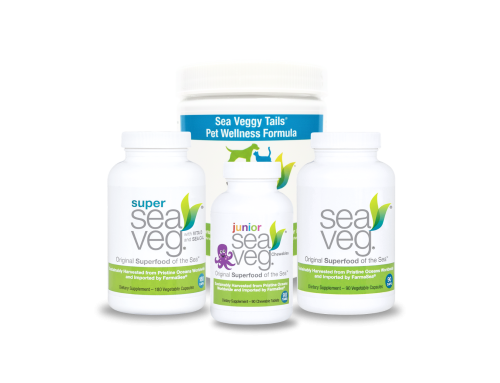
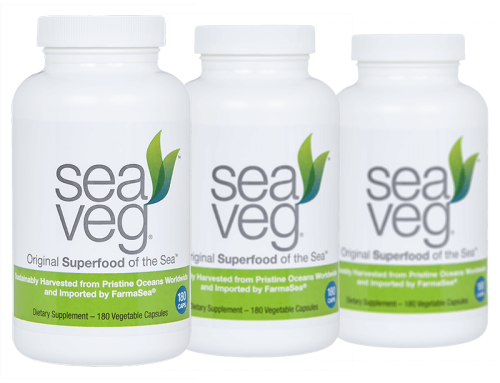
Sea Veg®’s formula brings together 12 wild-harvested species — with a boosted concentration of wakame specifically for its fucoidan content. The result is a nutritional profile that no single-species sea moss product and no synthetic multivitamin comes close to matching.
It’s the difference between a single instrument and a full orchestra.
Sea Veg®: What We Built Instead
I called it Sea Veg® deliberately. Because that’s exactly what it is — a rejection of the synthetic supplement model and a return to something your body actually knows how to use.
Sea Veg® is wild-harvested from pristine ocean waters — not farmed, not processed beyond what’s needed to preserve potency, not bulked up with synthetic fillers. The nutrients arrive in the whole-food matrix they evolved in: naturally bonded with the cofactors and supporting compounds into a single seaweed supplement that make absorption and utilization possible.
The people who find Sea Veg® and try it often say the same thing: “I can’t believe I waited so long to try this.”
I understand that feeling. I lived it. That’s why I built this company — not because it was a business opportunity, but because I found something that actually worked after years of trying things that didn’t.
“We’re not in it for the money. We’re in it for your health.” That’s not marketing language. It’s the reason Sea Veg® exists.
What to Expect When You Make the Switch
Most Sea Veg® customers report noticing changes within 2–4 weeks of consistent daily use. The most common early reports include:
- More consistent energy throughout the day without spikes or crashes
- Better recovery after exercise or physical activity
- Improved sleep quality
- Clearer thinking and less mental fog
- Stronger nails and improved hair texture
Results vary by individual, depending on baseline nutrition, lifestyle, and which nutrient gaps the sea plants are filling. Customers with lower iodine levels (common in many parts of the US and Canada) often notice the most dramatic early improvements.
The burn recovery case that still moves me most: a mother wrote to us after her son’s third-degree burn recovery exceeded what his medical team expected. Doctors were amazed. She credited Sea Veg®. I can’t make clinical claims — but I can tell you that story is why we do what we do.
Making the Switch: A Simple Starting Point
If you’ve been taking a daily multivitamin, you don’t need to throw it away tomorrow. The simplest starting point is to try adding Sea Veg® alongside your current routine for 30 days and pay attention to how you feel.
Then ask yourself: does my body know the difference?
In my experience — and in the experience of thousands of Sea Veg® customers — it does.
Ready to experience the Sea Veg® difference?
Explore our full range of wild-harvested Sea Veg® infusions and discover the difference of whole-food bioavailability. From essential minerals to rare marine compounds, find the formula that completes your nutritional puzzle.